| Available Feedstock |
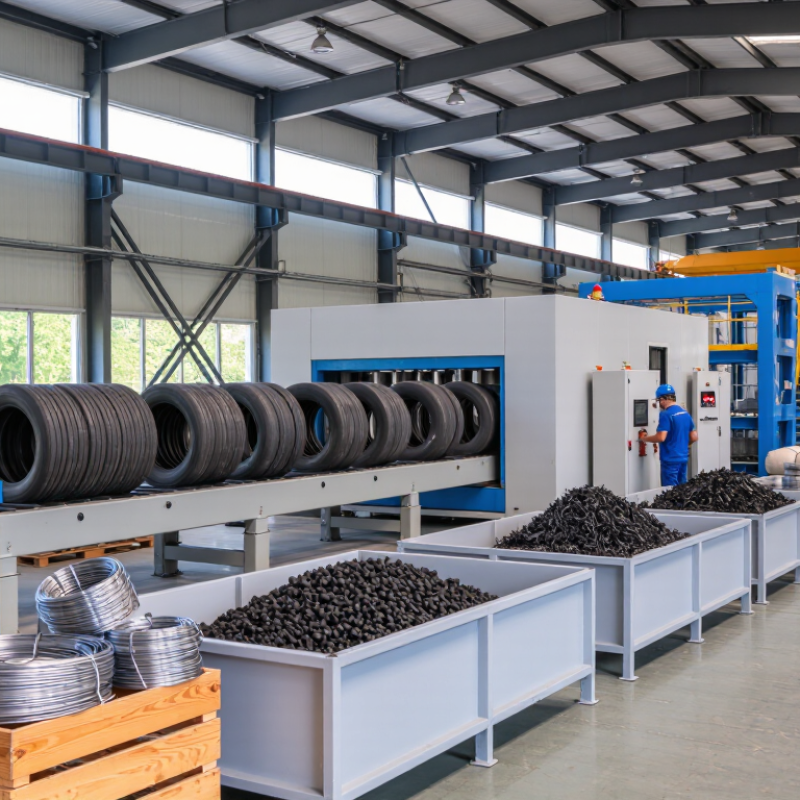
1 tonne of waste tyres typically contains approximately 650–750 kg of rubber, 100–180 kg of steel, and 50–150 kg of textile or other material. |
The material composition determines the potential product mix and affects separation, cleaning, storage, and sales requirements. |
Confirm tyre types, monthly supply volume, moisture content, and whether passenger-car, truck, or mixed tyres will be processed. |
| Processing Capacity |
Small and medium systems commonly operate in the range of 0.5–2.0 tonnes per hour. |
Capacity must match the available feedstock. Oversizing increases capital cost and may leave equipment underutilized. |
Base the selection on actual annual tyre availability, operating shifts, planned maintenance, and seasonal supply fluctuations. |
| Operating Schedule |
A two-shift operation may provide approximately 3,000–6,000 operating hours per year, depending on maintenance and local working practices. |
Annual throughput is determined by capacity multiplied by realistic operating hours, not by the machine’s maximum rated capacity alone. |
Use a conservative utilization assumption of approximately 60–80% during the first operating year. |
| Output Products |
Typical outputs include rubber granules or powder, recovered steel, and textile fibre. |
Different output sizes require different screens, mills, magnetic separators, dust-control equipment, and quality-control procedures. |
Choose the final product size according to confirmed customer specifications rather than selecting equipment based only on throughput. |
| Rubber Recovery |
A well-designed mechanical process may recover approximately 65–75% of tyre input as rubber-rich material, depending on tyre composition and product specifications. |
Higher purity and finer particle sizes generally require additional processing stages and may increase energy use and maintenance costs. |
Request test results for rubber purity, particle-size distribution, residual steel, and residual textile content using representative local tyres. |
| Steel Recovery |
Recovered steel commonly represents approximately 10–18% of tyre input, depending on tyre type and the degree of fibre and rubber removal. |
Steel recovery can provide an additional revenue stream and reduces contamination in the rubber product. |
Evaluate magnetic-separation efficiency, residual rubber on steel, storage requirements, and local scrap-metal acceptance criteria. |
| Energy Consumption |
Mechanical tyre shredding and granulation systems may use approximately 150–350 kWh per tonne, depending on output size, tyre type, and equipment configuration. |
Electricity is a major variable operating cost, especially when producing fine rubber powder or processing heavily reinforced truck tyres. |
Compare specific energy consumption at the required product size and calculate costs using the local industrial electricity tariff. |
| Land and Layout |
A complete line may require several hundred square metres when processing, feeding, storage, maintenance, and finished-product areas are included. |
Insufficient space can restrict material flow, increase handling costs, and create safety or fire-control problems. |
Prepare a layout that includes tyre storage, fire lanes, equipment access, dust-control zones, product storage, and truck loading areas. |
| Labour Requirements |
A semi-automated line may require approximately 3–8 workers per shift, depending on automation, feeding method, packaging, and material handling. |
Labour costs depend not only on machine operation but also on sorting, feeding, quality inspection, maintenance, and warehouse activities. |
Calculate staffing by shift and include training, absences, supervision, forklift operation, and maintenance coverage. |
| Maintenance and Wear Parts |
Cutting knives, screens, bearings, belts, and dust-collection components are routine wear items. Replacement intervals vary from weeks to months according to tyre type and throughput. |
Unexpected downtime can reduce annual output and cause missed deliveries. Wear-part availability is therefore a key investment factor. |
Obtain a recommended spare-parts list, expected service intervals, maintenance procedures, and local technical-support arrangements. |
| Fire and Dust Control |
Tyre storage and processing require fire prevention, temperature monitoring, housekeeping, ventilation, and dust-control measures. |
Tyre-derived rubber dust can create workplace and equipment risks if it is not properly captured and managed. |
Check local fire codes, dust-extraction requirements, emergency access, sprinkler or suppression systems, and insurance conditions before installation. |
| Product Quality |
Common quality indicators include particle size, rubber purity, moisture, residual steel, residual textile, and bulk density. |
Higher-value applications generally require tighter specifications and more consistent batch quality. |
Secure written product specifications or sample-approval requirements from prospective customers before finalizing the process design. |
| Revenue Sources |
Potential income may come from tipping or processing fees, rubber products, recovered steel, and selected fibre applications. |
Multiple revenue streams can reduce dependence on a single commodity market, but each stream has different quality and logistics requirements. |
Build separate conservative, expected, and optimistic scenarios for each product and verify transport, packaging, and buyer deductions. |
| Payback Evaluation |
A reliable payback estimate requires actual capital cost, utilization, electricity, labour, maintenance, transport, disposal fees, and product prices. |
Payback based only on machine price and expected sales can materially overstate profitability. |
Use a sensitivity analysis for throughput, product price, electricity cost, downtime, and feedstock availability before approving the investment. |
| Regulatory Position |
Requirements may cover waste-transport permits, environmental approvals, noise, dust emissions, fire safety, worker protection, and waste-storage limits. |
Permitting delays or additional compliance costs can affect both project timing and total investment. |
Obtain written confirmation from the relevant local authorities before ordering equipment or signing a long-term supply agreement. |
| Investment Suitability |
The project is strongest when feedstock is secure, products have confirmed buyers, utilities are available, and the line can operate near its practical capacity. |
A technically capable machine cannot compensate for weak feedstock supply, uncertain markets, inadequate space, or insufficient working capital. |
Proceed only after validating supply contracts, customer demand, site readiness, financing, compliance, and a conservative cash-flow model. |